

What Causes Bone Loss in Osteoporosis?
At Jean Walter Infusion Center, Dr. Nasser Nasseri, MD leads a specialized clinical team dedicated to diagnosing and treating the root causes of skeletal degeneration. Our center provides a sophisticated environment for patients to receive targeted therapies that address bone density loss at the cellular level. By combining clinical expertise with advanced infusion technology, Dr. Nasseri ensures that each patient receives a comprehensive plan to stop the progression of bone thinning and restore the structural integrity of their skeletal system. For more information, contact us or book an appointment online. We are conveniently located at 3333 N. Calvert St, Suite 540A, Baltimore, MD 21218.
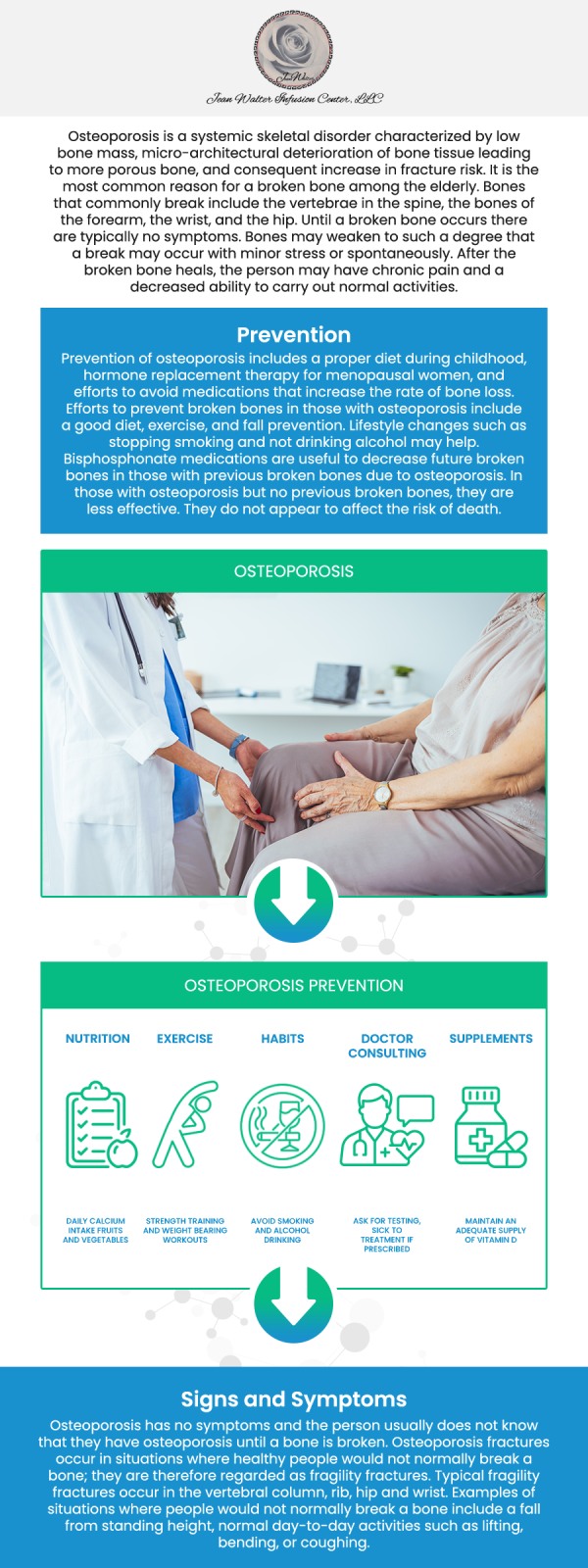
Table of Contents:
What are the primary factors that lead to bone loss in osteoporosis?
How does a decrease in bone density contribute to osteoporosis?
Is bone loss purely genetic, or do lifestyle factors like smoking and lack of exercise play a major role?
How do underlying medical conditions, such as thyroid problems or autoimmune diseases, trigger secondary osteoporosis?
The Leading Causes of Bone Loss in Osteoporosis Explained by Dr. Nasser Nasseri, MD at Jean Walter Infusion Center
Bone loss occurs when the natural “remodeling” cycle of the body falls out of balance. Under normal circumstances, your body constantly removes old bone tissue (resorption) and replaces it with new bone (formation). In patients with osteoporosis, this cycle is disrupted—either the body removes bone too quickly, or it fails to replace it fast enough.
The primary drivers of this imbalance are often hormonal. In women, the sharp decline in estrogen during menopause is a leading factor, as estrogen is crucial for maintaining bone strength. Similarly, in men, a gradual decline in testosterone can lead to weakened bones. Additionally, as we age, our bodies become less efficient at absorbing essential minerals, leading to a net loss in bone mass over time.
Think of bone density as the “architectural thickness” of your skeleton. Healthy bones have a dense, tightly woven internal structure that looks like a strong sponge. As bone density decreases, the “holes” within this sponge-like structure become larger and more numerous.
This loss of density directly reduces the bone’s ability to withstand mechanical stress. When density drops below a certain threshold, the bone becomes “porous” (hence the term osteoporosis). At this stage, the bone is no longer a solid support system but a fragile shell that can fracture under the simple weight of the body or during routine movements like bending over or lifting a grocery bag.
While genetics certainly provide the “blueprint” for your peak bone mass—meaning if your parents had osteoporosis, you are at a higher risk—lifestyle factors act as the primary modifiers of that risk.
• Smoking: Tobacco use is a direct toxin to bone cells. It reduces blood flow to the bones and interferes with the absorption of calcium.
• Physical Inactivity: Bones are dynamic tissues that grow stronger when stressed. A sedentary lifestyle tells the body that dense bones aren’t “necessary,” leading to faster thinning.
• Alcohol Consumption: Chronic heavy drinking can interfere with the calcium balance and the hormones that protect the bone.
• Nutrition: A lifelong deficiency in Calcium and Vitamin D creates a “withdrawal” from the bone’s mineral bank that eventually leads to bankruptcy (osteoporosis).
Sometimes, bone loss isn’t just a result of aging or lifestyle; it is a “secondary” effect of another health issue. This is known as secondary osteoporosis.
• Thyroid and Endocrine Issues: Overactive thyroid (hyperthyroidism) or overactive parathyroid glands can force the body to pull too much calcium out of the bones and into the bloodstream.
• Autoimmune Diseases: Conditions like rheumatoid arthritis or lupus involve chronic inflammation, which triggers bone-destroying cells. Furthermore, the corticosteroids often used to treat these diseases are notorious for causing rapid bone loss.
• Malabsorption Issues: Celiac disease or inflammatory bowel disease (IBD) can prevent the gut from absorbing the nutrients required to maintain the skeleton.
Determining the “why” behind bone loss is the specialty of Dr. Nasser Nasseri, MD. At Jean Walter Infusion Center, Dr. Nasseri moves beyond standard oral supplements to provide medical-grade solutions for complex cases of osteoporosis. He meticulously evaluates a patient’s medical history—looking for the “hidden” triggers like autoimmune markers or hormonal imbalances—and utilizes advanced infusion therapies. These treatments, such as intravenous bisphosphonates or monoclonal antibodies, are designed to bypass the digestive system, ensuring 100% bioavailability to target the bone-remodeling cycle directly and stop further degradation in its tracks.
The deterioration of bone is rarely caused by a single event; rather, it is the cumulative result of biological, environmental, and medical factors. When the internal scaffolding of the bone loses its mineral density, the risk of a “fragility fracture” skyrockets. Understanding that bone loss is a dynamic process is key—it means that while bone can be lost, its decline can also be slowed or even partially reversed through modern medical intervention. By addressing the cellular mechanics of bone resorption, we can change the trajectory of the disease.
Bone loss may be a complex biological process, but it is one that can be managed with the right expertise. From hormonal shifts to the impact of underlying autoimmune conditions, the path to osteoporosis is varied. However, with the clinical leadership of Dr. Nasser Nasseri, MD at Jean Walter Infusion Center, patients have access to the most modern treatments available to combat these causes. Taking proactive steps today to understand your risk factors is the most effective way to ensure a mobile and fracture-free future. For more information, contact us or book an appointment online. We are conveniently located at 3333 N. Calvert St, Suite 540A, Baltimore, MD 21218. We serve clients from North Baltimore MD, Dundalk MD, Halethrope MD, Ferndale MD, Yorktown MD, and surrounding areas.
Check Out Our 5 Star Reviews

Additional Services We Offer


- Infusion Therapy
- Injection Treatments
- Intravenous Immunoglobulin Therapy
- Medical Conditions
- Asthma
- Crohn’s Disease
- Fibromyalgia
- Gout
- Inflammatory Eye Disease
- Inflammatory Skin Disease
- Iron Deficiency
- Lupus
- Multiple Sclerosis
- Myositis
- Osteoporosis
- Rheumatoid Arthritis
- Ulcerative Colitis
- Vasculitis
- IVIG Infusions
- Platelet-Rich Plasma (PRP)


 Send Text
 How May I Help You?