

What Is Osteoporosis and Why Does It Weaken Bones Over Time?
At Jean Walter Infusion Center, Dr. Nasser Nasseri, MD, and his dedicated team provide specialized care for patients navigating the complexities of bone health. Understanding osteoporosis is the first step toward protecting your mobility and independence. Under the guidance of Dr. Nasseri, our clinic offers advanced infusion therapies designed to strengthen bone density and reduce the risk of life-altering fractures, ensuring you receive personalized medical attention tailored to your specific skeletal needs. For more information, contact us today or book an appointment online now! We are conveniently located at 9114 Philadelphia Rd, Suite 208A, Rosedale, MD 21237.
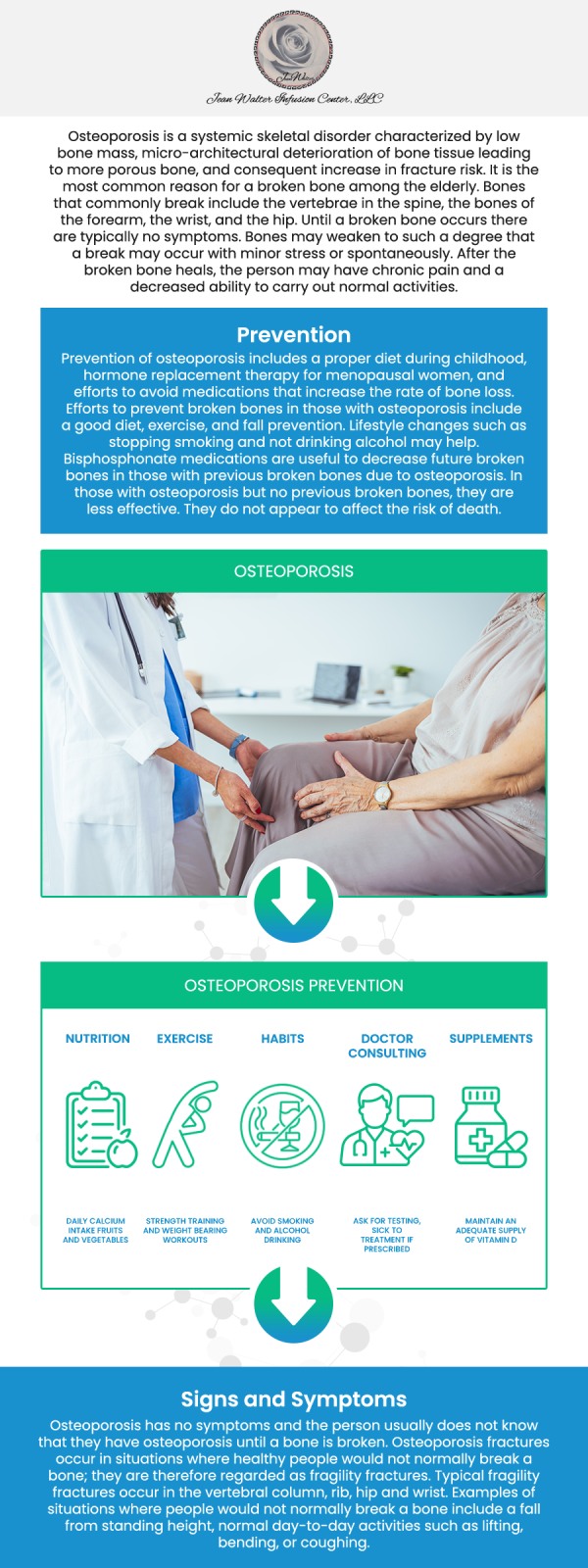
Table of Contents:
Is osteoporosis a silent disease, or are there early warning signs before a bone actually breaks?
What are the common symptoms of osteoporosis?
Can early lifestyle habits, such as calcium intake and weight-bearing exercise, help prevent osteoporosis?
Does osteoporosis weaken all bones equally, or are the hips, spine, and wrists more vulnerable to fractures?
Osteoporosis Explained: Why It Weakens Bones and How Dr. Nasser Nasseri, MD Can Help at Jean Walter Infusion Center
Osteoporosis is frequently referred to as a “silent disease” because bone loss typically occurs without any outward symptoms or pain. Many individuals remain unaware that their skeletal structure is thinning until a sudden strain, bump, or fall causes a bone to break.
However, there are subtle “red flags” that may appear before a major fracture occurs. These include a noticeable loss of height (caused by weakened vertebrae), a change in posture such as stooping or a “dowager’s hump,” and persistent back pain resulting from collapsed or fractured vertebrae. While these signs are not always present in the early stages, they serve as critical indicators that the bone remodeling process—the balance between old bone removal and new bone formation—has been compromised.
Because the condition progresses quietly, the “symptoms” are often the physical consequences of weakened bones rather than internal pain. The most common clinical manifestations include:
• Fragility Fractures: Breaking a bone from a minor incident, such as a sneeze, a cough, or a fall from standing height.
• Loss of Height: Over time, the bones in the spine (vertebrae) can weaken and compress, leading to a loss of one or more inches in height.
• Receding Gums: If the jawbone loses density, gums may begin to recede, which can be detected during dental exams.
• Weakened Grip Strength: Studies have shown a correlation between low handgrip strength and low bone mineral density.
• Kyphosis: A curving of the upper back (slumping) that occurs when the spine can no longer support the body’s weight.
Prevention is the most effective tool in the fight against bone loss. Bone mass peaks around the age of 30; therefore, habits formed early in life act as an “insurance policy” for your skeleton.
• Calcium and Vitamin D: Calcium is the primary building block of bone tissue, while Vitamin D is essential for the body to absorb that calcium. A diet rich in dairy, leafy greens, and fortified foods is vital.
• Weight-Bearing Exercise: Activities that force you to work against gravity—such as walking, hiking, jogging, or weightlifting—stimulate bone-forming cells (osteoblasts).
• Avoiding Bone Depletors: Chronic smoking and excessive alcohol consumption interfere with bone-building cells and increase the rate of bone loss.
By prioritizing these habits in early adulthood and maintaining them through middle age, individuals can significantly delay the onset of bone thinning.
While osteoporosis affects the entire skeleton, it does not impact all bones with the same level of severity. The disease primarily targets “trabecular” or spongy bone, which is more metabolically active than “cortical” or hard outer bone.
The hips, spine, and wrists are the most vulnerable areas. Spinal fractures are the most common and can occur even without a fall. Hip fractures are the most serious, often requiring major surgery and long-term rehabilitation. The wrist is frequently broken because it is the first point of impact when a person reaches out to break a fall. Because these areas are central to our mobility and daily function, protecting them through medical intervention is a priority at specialized facilities.
When it comes to managing chronic bone loss, Dr. Nasser Nasseri, MD brings a wealth of expertise to the Jean Walter Infusion Center. Dr. Nasseri understands that every patient’s bone density profile is unique, requiring a transition from general supplements to targeted medical intervention. He specializes in administering advanced injectable and infusion-based treatments—such as bisphosphonates and RANK ligand inhibitors—that are often more effective or better tolerated than oral medications. By focusing on the latest clinical protocols, Dr. Nasseri helps patients stabilize their bone density, effectively “locking in” bone strength to prevent the devastating cycle of repeated fractures.
To understand why bones weaken, one must look at the cellular level. Our bones are living tissue in a constant state of renewal. In a healthy body, “osteoclasts” break down old bone, and “osteoblasts” build new bone. Osteoporosis occurs when the breakdown exceeds the buildup. This creates a porous, honeycomb-like structure inside the bone. As the “holes” in the honeycomb grow larger, the internal architecture becomes brittle. What was once a flexible, sturdy support system becomes a fragile frame that can snap under the slightest pressure. This imbalance is often accelerated by hormonal changes, such as the drop in estrogen during menopause or the decline of testosterone in men.
Osteoporosis may be a silent threat, but it does not have to be an inevitable part of aging. Through a combination of early lifestyle interventions, regular bone density screenings, and modern medical treatments, you can maintain a strong and active lifestyle. Dr. Nasser Nasseri, MD and the professional staff at Jean Walter Infusion Center are committed to providing the specialized care necessary to fortify your skeletal health and protect your future mobility. For more information, contact us today or book an appointment online now! We are conveniently located at 9114 Philadelphia Rd, Suite 208A, Rosedale, MD 21237. We serve patients from Rosedale MD, Parkville MD, Middle River MD, Rossville MD, Overlea MD, and surrounding areas.
Check Out Our 5 Star Reviews

Additional Services We Offer


- Infusion Therapy
- Injection Treatments
- Intravenous Immunoglobulin Therapy
- Medical Conditions
- Asthma
- Crohn’s Disease
- Fibromyalgia
- Gout
- Inflammatory Eye Disease
- Inflammatory Skin Disease
- Iron Deficiency
- Lupus
- Multiple Sclerosis
- Myositis
- Osteoporosis
- Rheumatoid Arthritis
- Ulcerative Colitis
- Vasculitis
- IVIG Infusions
- Platelet-Rich Plasma (PRP)


 Send Text
 How May I Help You?