

Osteoporosis in Women: Early Signs, Causes and Prevention
At Jean Walter Infusion Center, Dr. Nasseri, MD and our dedicated clinical team specialize in providing advanced intravenous therapies and comprehensive bone health management. Understanding the “silent” nature of bone loss is the first step toward maintaining an active, independent lifestyle. Under the guidance of Dr. Nasseri, we provide patients with the latest diagnostic insights and infusion treatments designed to strengthen skeletal integrity and prevent debilitating fractures. For more information, contact us or request an appointment online. We are conveniently located at 3168 Braverton St., Suite 330A, Edgewater, MD 21037.
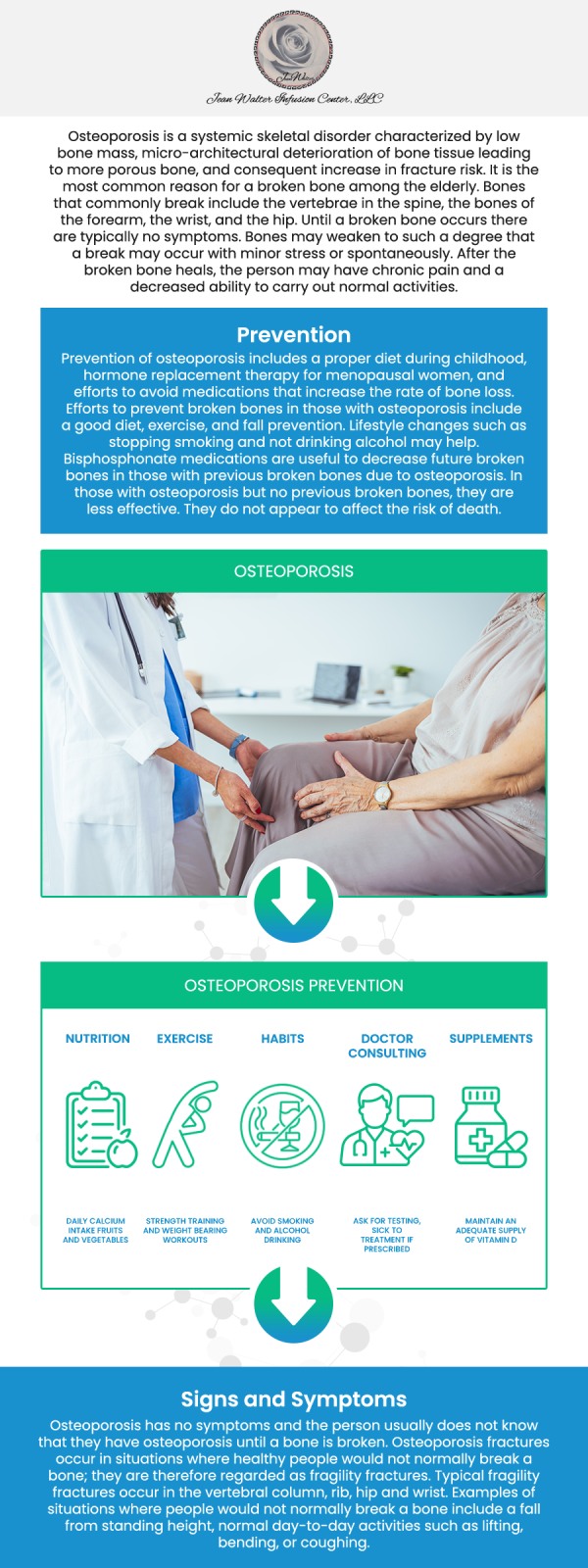
Table of Contents:
What are the early warning signs of osteoporosis in women?
Why are women at a higher risk, especially after menopause?
What is often the first visible indication of the condition?
When should a woman consult a medical provider for evaluation?
Why Choose Dr. Nasser Nasseri MD for Your Bone Health Journey?
Osteoporosis is frequently referred to as a “silent disease” because bone loss typically occurs without any outward symptoms or pain for many years. However, there are subtle physical cues that may indicate your bone density is beginning to wane before a major fracture occurs.
One of the most common early indicators is a noticeable loss of height. If you find that clothes fit differently or you are consistently measuring shorter during annual physicals, it may be due to “compression fractures” in the vertebrae. These are tiny cracks in the spinal bones that cause the spine to collapse slightly.
Another early sign is a change in posture, specifically the development of a curved upper back or a “widowed’s hump” (kyphosis). Persistent back pain, often caused by a weakened vertebra, is another red flag that should not be ignored. Furthermore, a receding gum line can sometimes be an early indicator of bone loss in the jaw, and a weakened grip strength has been clinically linked to lower systemic bone mineral density.
While osteoporosis can affect anyone, women are disproportionately impacted due to several biological and hormonal factors. Statistically, women tend to have smaller, thinner bones than men to begin with, meaning there is less “bone bank” to draw from as aging progresses.
The most significant factor, however, is the role of estrogen. Estrogen is a hormone that protects bone strength by regulating the activity of osteoclasts (cells that break down bone) and osteoblasts (cells that build bone). During the transition into menopause, estrogen levels drop precipitously. This hormonal shift accelerates bone resorption, meaning the body breaks down old bone faster than it can replace it. In the first five to seven years following menopause, a woman can lose up to 20% of her total bone density.
Additionally, women live longer on average than men. This longevity, while a blessing, provides more time for bone density to reach the threshold of osteoporosis, making preventive care and early intervention essential for female patients.
Because the internal degradation of bone tissue is painless, the first visible or tangible indication of osteoporosis is often a “fragility fracture.” This is a break that occurs from a minor incident that would not normally cause a healthy bone to snap—such as a fall from a standing height, a strong sneeze, or even bending over to tie a shoe.
The most frequent sites for these fractures are the wrist, hip, and spine. While a broken wrist is often the first sign in younger postmenopausal women, spinal fractures are frequently the first visible indicator in older women. These spinal changes manifest as a progressive stoop or the inability to stand up straight. This postural shift doesn’t just affect appearance; it can compress internal organs, leading to digestive issues or shortness of breath. If you notice that your abdomen is protruding more than usual despite no weight gain, it may actually be a result of your ribs moving closer to your pelvis due to a shortening spine.
Proactive screening is the gold standard for preventing the life-altering consequences of bone loss. A woman should consult a medical provider for a formal evaluation, typically involving a Dual-Energy X-ray Absorptiometry (DEXA) scan, in the following scenarios:
• Age-Based Screening: Most health organizations recommend routine bone density testing for all women starting at age 65.
• Early Menopause: If you experienced menopause before age 45, whether naturally or surgically (such as a hysterectomy), you should be evaluated much earlier.
• Family History: If a parent suffered a hip fracture or had a known diagnosis of osteoporosis, your genetic risk is significantly higher.
• Medication Use: Long-term use of corticosteroid medications (like prednisone), certain anti-seizure drugs, or breast cancer treatments can accelerate bone thinning.
• Physical Changes: If you have lost more than 1.5 inches of your original height or have developed a stooped posture, an immediate evaluation is necessary.
When it comes to managing complex bone conditions, the expertise of your specialist makes all the difference. Dr. Nasseri combines years of clinical experience with a personalized approach to immunology and infusion medicine. At our clinic, Dr. Nasseri doesn’t just treat the numbers on a scan; he treats the whole person. Our suite of treatments includes the latest FDA-approved bone-building infusions and RANK ligand inhibitors, which are often more convenient and effective than daily oral medications. Whether you are focused on prevention or need intensive treatment for existing bone loss, Dr. Nasseri ensures your care plan is tailored to your specific hormonal profile and lifestyle needs.
Osteoporosis does not have to be an inevitable part of aging. Through a combination of weight-bearing exercise, adequate Vitamin D and Calcium intake, and advanced medical interventions, you can protect your mobility for years to come. If you are concerned about your bone health or have recently experienced a fracture, do not wait for the condition to progress. Visit Jean Walter Infusion for a comprehensive consultation and take the first step toward a stronger, more resilient skeletal system. Your bone health is our priority, and we are here to support you every step of the way. For more information, contact us or request an appointment online. We are conveniently located at 3168 Braverton St., Suite 330A, Edgewater, MD 21037. We serve patients from Edgewater MD, Riva MD, Davidsonville MD, Annapolis MD, and surrounding areas.
Check Out Our 5 Star Reviews

Additional Services We Offer


- Infusion Therapy
- Injection Treatments
- Intravenous Immunoglobulin Therapy
- Medical Conditions
- Asthma
- Crohn’s Disease
- Fibromyalgia
- Gout
- Inflammatory Eye Disease
- Inflammatory Skin Disease
- Iron Deficiency
- Lupus
- Multiple Sclerosis
- Myositis
- Osteoporosis
- Rheumatoid Arthritis
- Ulcerative Colitis
- Vasculitis
- IVIG Infusions
- Platelet-Rich Plasma (PRP)


 Send Text
 How May I Help You?